Evaluating the Girl Who Loves Books Design for Creative Projects
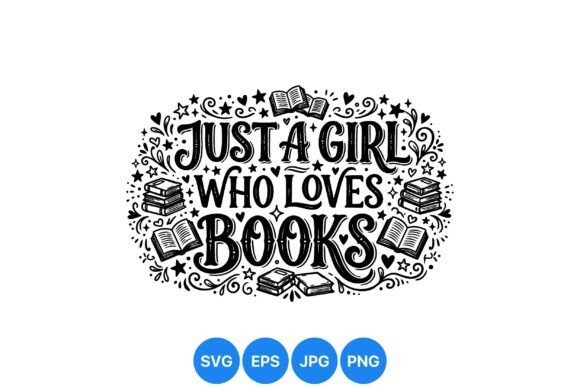
In the realm of digital crafting and graphic design, specific motifs resonate deeply with niche communities. The Girl Who Loves Books Design is one such asset, characterized by a playful hand-lettered phrase surrounded by swirling decorative elements and stacks of books. This artwork expresses a profound love for reading through an elegant black and white vector aesthetic. For designers, hobbyists, and small business owners, understanding the technical specifications and artistic merits of this design is crucial before integrating it into commercial or personal projects.
Understanding the Design Aesthetic
The core appeal of the Girl Who Loves Books Design lies in its balance between whimsy and sophistication. The hand-lettered typography offers a personal, human touch that rigid, computer-generated fonts often lack. This is complemented by intricate swirling elements and illustrated book stacks, which frame the text and provide visual interest without overwhelming the central message. The choice of a high-contrast black and white palette is not merely stylistic; it is functional. This monochromatic approach ensures versatility, allowing the design to be easily adapted to various backgrounds and material colors without clashing.
As a vector-based artwork, the design is constructed using mathematical paths rather than pixels. This distinction is vital for users who require scalability. Whether the image is printed on a small sticker or enlarged for a tote bag, the lines remain crisp and sharp. The inclusion of 100% vector formats such as SVG and EPS guarantees that there is no loss of quality regardless of the dimensions applied during the production process.
Technical Specifications and File Formats
When evaluating digital assets, the included file types determine compatibility with different software and hardware. The download package for this design typically includes a ZIP folder containing SVG, PNG, JPG, and EPS files. Each format serves a distinct purpose in the workflow of a creator:
- SVG (Scalable Vector Graphics): Ideal for web use and compatible with most modern cutting machines like Cricut and Silhouette. It allows for easy manipulation of individual elements within design software.
- EPS (Encapsulated PostScript): A standard vector format preferred by professional graphic designers using Adobe Illustrator or CorelDRAW. It ensures maximum editability for complex modifications.
- PNG (Portable Network Graphics): A raster format with a transparent background. This is useful for quick drag-and-drop applications in digital mockups or sublimation printing where vector editing is not required.
- JPG (Joint Photographic Experts Group): A standard image format suitable for previews or simple printing tasks where transparency is not needed.
Having access to this comprehensive suite of files means that users are not locked into a single workflow. A crafter using a cutting machine can utilize the SVG, while a print-on-demand seller might prefer the high-resolution PNG for mockups.
Practical Applications and Use Cases
The Girl Who Loves Books Design is particularly well-suited for products targeting the literary community. Its strong fit is evident in several specific scenarios:
- Apparel and Textiles: The high-contrast nature of the design makes it excellent for screen printing or heat transfer vinyl (HTV) on t-shirts, hoodies, and library bags. The clean lines ensure that fine details do not get lost in the fabric texture.
- Stationery and Paper Goods: Bookmarks, journal covers, and reading logs benefit from the elegant typography. The vector format allows for precise sizing to fit standard paper dimensions without pixelation.
- Home Decor: Wall art prints, canvas decorations, and ceramic mugs can feature this design effectively. The black and white scheme integrates seamlessly into minimalist or modern interior design styles.
For individuals creating gifts for teachers, librarians, or avid readers, this design offers a ready-made solution that conveys sentiment without requiring advanced illustration skills. The pre-composed layout saves time, allowing creators to focus on production and marketing rather than design execution.
Considerations and Tradeoffs
While the design offers significant advantages, potential users should consider certain tradeoffs. The primary limitation is its fixed stylistic direction. The hand-lettered phrase and specific arrangement of books are static. Users seeking a fully customizable text field may find this restrictive unless they possess the skills to deconstruct and modify the vector paths extensively. Additionally, while the black and white scheme is versatile, it requires the user to add color if a vibrant aesthetic is desired. This adds a step to the workflow, requiring careful color theory application to maintain the design’s elegance.
Another consideration is the target audience. The theme is explicitly literary. While this is a strength for niche marketing, it limits the design’s applicability to broader, non-reading-related contexts. Businesses looking for generic decorative elements may find this too specific to their needs.
Comparing Alternatives
When deciding whether this design aligns with your goals, it is helpful to compare it with alternatives. Generic clipart libraries offer vast quantities of book-related images, but they often lack the cohesive artistic vision found in the Girl Who Loves Books Design. Free resources may provide similar themes but often come with licensing restrictions or lower resolution files that are unsuitable for commercial printing.
Conversely, hiring a custom illustrator provides total creative control but comes with significantly higher costs and longer turnaround times. For small businesses or hobbyists operating with limited budgets and tight deadlines, purchasing a pre-made, high-quality vector design like this one offers a balanced middle ground. It provides professional-grade aesthetics at a fraction of the cost of custom work.
Making the Right Decision
To determine if this design is the right choice, evaluate your technical capabilities and project requirements. If you have access to vector editing software or a cutting machine, the SVG and EPS files will provide maximum flexibility. If you are primarily working with digital mockups or simple printing, the PNG and JPG files may suffice. Consider your end product: if you are creating items for a bookstore, a school library fundraiser, or a reading club, this design’s thematic relevance is a strong asset.
However, if your brand identity relies heavily on bright, multi-colored palettes or if you need to frequently change the textual content of your designs, you may need to invest more time in customization or seek a different type of asset. Ultimately, the Girl Who Loves Books Design serves as a robust, high-quality foundation for literary-themed projects, offering a blend of artistic charm and technical reliability that supports both novice crafters and experienced designers.